

Baltany Watch Movements Explained — Every Caliber, Compared and Ranked (2026)
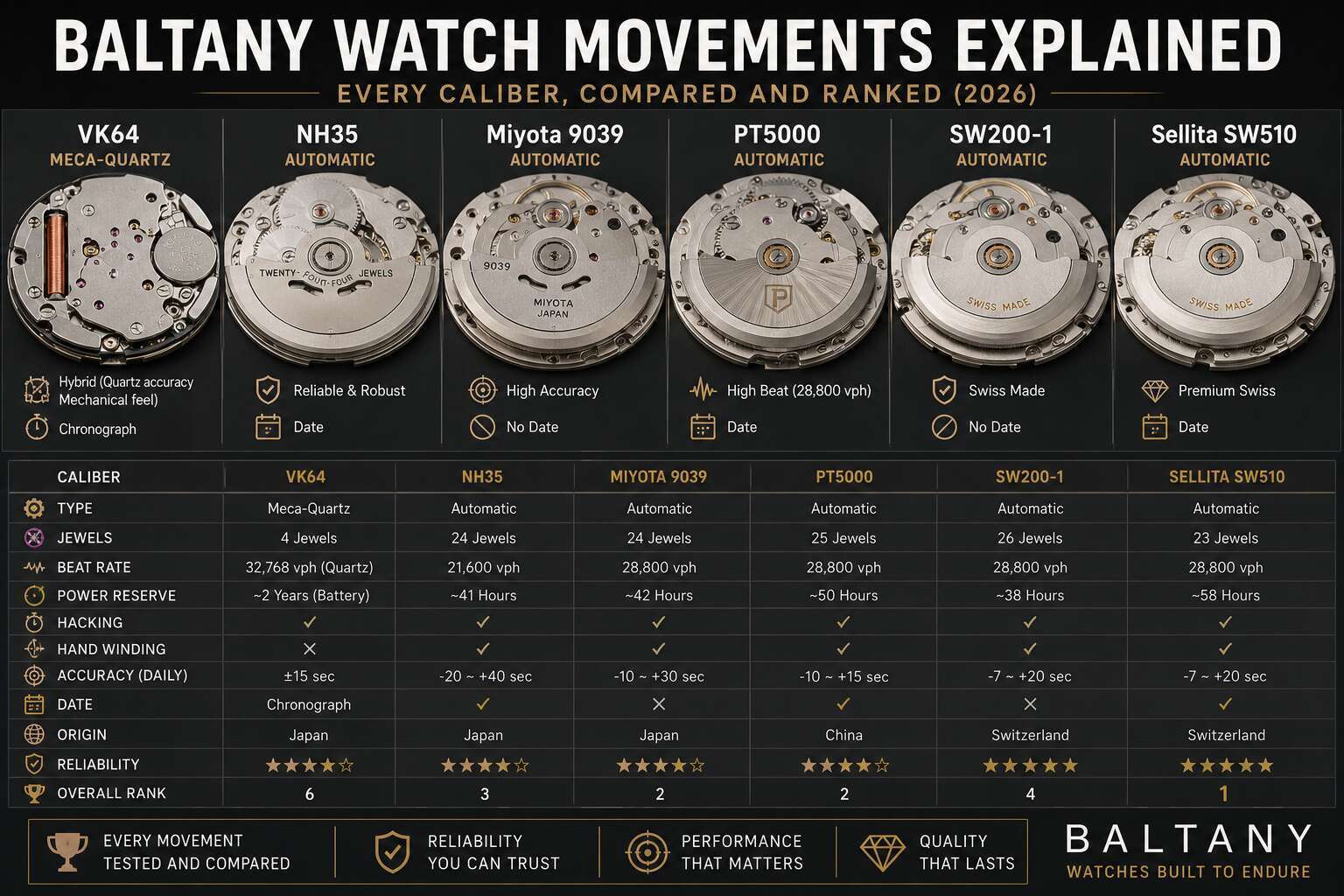
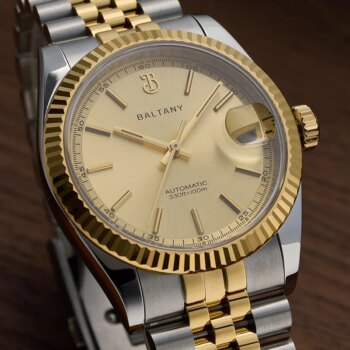
Choosing the right Baltany watch often comes down to choosing the right movement. Several Baltany models offer a direct movement choice at purchase — NH38 or SW200 in the S4056, ST2130 or SW200 in the S204035, ST1700 or ST1701 in the S4092 and S4101 — and understanding the actual differences between these calibers is the difference between buying the right watch and regretting the decision later.
This guide covers every movement used in the Baltany range: what it is, where it comes from, how it performs in practice, and who should choose it.
Quick Reference: Every Baltany Movement
| Movement | Type | Origin | Beat Rate | Hacking | Date | Used In |
|---|---|---|---|---|---|---|
| Seagull ST1700 | Manual-wind | China | 21,600 vph | No | No | S4092, S4101 |
| Seagull ST1701 | Automatic | China | 21,600 vph | No | No | D12 S2025, S4036, S4101, S4092 |
| Seagull ST1731 | Automatic | China | 21,600 vph | No | Yes | S2081 |
| Seagull ST3600 | Manual-wind | China | 21,600 vph | No | No | S4009H |
| Seiko NH38 | Automatic | Japan | 21,600 vph | No | No | W10, A11, S4056, S203043 |
| Seiko NH35 | Automatic | Japan | 21,600 vph | Yes | Yes | S4084, S4095, S4102 |
| Seiko NH34 | GMT Automatic | Japan | 21,600 vph | Yes | Yes | S6074 |
| Swiss SW200 | Automatic | Switzerland | 28,800 vph | Yes | No | S4056 (option), S204035 (option) |
| Miyota 9015 | Automatic | Japan | 28,800 vph | Yes | No | UK 1926 |
| Miyota 9039 | Automatic | Japan | 28,800 vph | Yes | No | S4090 |
| Miyota 9122 | Automatic | Japan | 28,800 vph | Yes | Yes + Day + Month | S6047 |
| Miyota 82S7 | Automatic | Japan | 21,600 vph | No | No | S4098 |
| Seiko VD78 | Solar Quartz | Japan | — | — | No | D12 quartz, S184012, S182027 |
| Seiko VK64 | Meca-Quartz | Japan | — | — | No | S205034, S205043 |
| Seiko VK67 | Meca-Quartz | Japan | — | — | Yes | S205045 |
| Ronda 715Li | Quartz (10yr) | Switzerland | — | — | No | S2082 |
The Automatic Movements
Seiko NH38 — The Most Common Baltany Caliber
The NH38 is the movement in more Baltany watches than any other — the W10, A11, S4056 (standard), S203043 and S2204030 all use it. It is manufactured by Seiko Instruments Inc. in Japan and is the no-date variant of the NH35.
Specifications:
- 21,600 vibrations per hour (3 Hz)
- 41-hour power reserve
- Bidirectional automatic winding
- No hacking — the seconds hand continues running when the crown is pulled for time-setting
- No date
- Hand-winding via the crown
The no-hacking limitation in practice: pulling the crown to set the time does not stop the seconds hand. This means you cannot precisely synchronise the watch to the second without a technique called “the crown trick” — pulling the crown at the exact moment the reference second passes. For most daily wear this is irrelevant. For buyers who need second-precise timekeeping, choose NH35 or SW200 instead.
Why Baltany uses NH38 on military models: the no-date configuration keeps the military dial layouts uninterrupted at the 3 o’clock position. On a watch designed around historical military specifications — where a date window was not part of the original design — the NH38 is the correct choice.
Long-term serviceability: NH38-based movements are serviced globally by any watchmaker familiar with Seiko calibers. Parts are widely available. A typical NH38 service interval is every 3–5 years of heavy daily wear, or every 5–7 years for moderate use.
Seiko NH35 — Baltany’s Date Caliber
The NH35 is the date-equipped version of the NH38, used in the S4084, S4095 and S4102. The addition of a date complication also adds hacking capability — the seconds hand stops when the crown is pulled, allowing precise time-setting to the second.
Specifications:
- 21,600 vph
- 41-hour power reserve
- Bidirectional automatic winding
- Hacking — seconds stop when crown is fully pulled
- Hand-winding via crown
- Date display at 3 o’clock
Why hacking matters on dress watches: a dress watch worn to meetings and professional settings is typically set to match room clocks and phones, which display time to the second. The ability to stop the seconds hand and synchronise precisely is a practical feature on a watch where accuracy presentation matters.
The NH35 is the most widely serviced automatic movement in the world. Every watchmaker, from an independent repair shop to a certified service centre, can service an NH35. This is the correct movement choice for buyers who plan to own and maintain a watch long-term.
Seiko NH34 — The GMT Caliber
The NH34 is a dedicated GMT automatic used exclusively in the Baltany S6074. Unlike most affordable GMT watches that use a standard movement with a GMT module added on top, the NH34 is a purpose-built GMT caliber with the 24-hour hand architecture integrated into the base movement.
Specifications:
- 21,600 vph
- Bidirectional automatic winding
- Hacking
- Hand-winding
- Independent 24-hour GMT hand (second time zone)
- Date display
- Hour-jump setting — the main hour hand can be advanced in one-hour increments without disturbing the GMT hand or running movement
The hour-jump function is the NH34’s key practical advantage. When crossing time zones, pull the crown to position 1 (first click) and advance the hour hand in one-hour steps to local time. The GMT hand and running movement are unaffected. This is significantly more convenient than stopping the movement to reset time, as required on GMT module-based calibers.
Swiss SW200 — The Premium Baltany Movement Choice
The SW200 is manufactured by Sellita in Switzerland and is available as the premium movement option in the S4056 and S204035. It is the most technically capable automatic movement in the standard Baltany range.
Specifications:
- 28,800 vph — significantly higher beat rate than any Seiko NH-series caliber
- 38-hour power reserve
- Bidirectional automatic winding
- Hacking
- Hand-winding
- No date (in S4056 and S204035 applications)
- Swiss manufacture
28,800 vph vs 21,600 vph — what the difference looks like: at 21,600 vph (NH38, NH35) the seconds hand advances in 6 steps per second, producing a slightly ticked motion. At 28,800 vph (SW200) it advances in 8 steps per second, producing a noticeably smoother sweep. The difference is visible when you look closely and is the most immediately apparent quality indicator on a mechanical watch.
Swiss manufacture: the SW200 is made in Switzerland to Swiss industry finishing standards. For buyers who specifically want Swiss-made movement provenance — for personal, cultural or collector reasons — the SW200 is the only Swiss-made automatic movement option in the Baltany range.
Who should choose SW200 over NH38: buyers who want the smoothest possible seconds sweep, Swiss manufacture provenance, or hacking capability in the S4056 or S204035. The SW200 variant costs more than the NH38 option; the case, dial and all other specifications are identical.
Miyota 9039 — Best Automatic in the Baltany Range
The Miyota 9039 is manufactured by Citizen’s Miyota division and is used exclusively in the S4090 Pie-Pan. It is the highest-specification automatic movement in the entire Baltany range.
Specifications:
- 28,800 vph high-beat
- ~42-hour power reserve
- Bidirectional automatic winding
- Hacking
- Hand-winding
- No date — preserving full dial symmetry on the S4090
Why the 9039 matters: most affordable automatic watches use movements beating at 21,600 vph. The 9039 beats at 28,800 vph — the same rate used in professional Swiss movements significantly more expensive. Combined with the S4090’s 500HV hardened case, the Miyota 9039 places the S4090 in a different specification tier from other Baltany models. If movement quality is your primary criterion, the S4090 is the correct Baltany.
Miyota 9015 — High-Beat with Hacking
The Miyota 9015 is used in the Baltany UK 1926 — a 28,800 vph automatic with hacking and hand-winding. It is an intermediate specification between the NH38/NH35 family and the 9039, offering the high-beat sweep of the SW200 with broad serviceability.
Miyota 9122 — Complete Calendar
The Miyota 9122 is the most complex movement in the Baltany range, used in the S6047. It displays weekday, date and month simultaneously on a three-register dial. No other Baltany movement provides this complication level.
Month-end correction: the 9122 does not distinguish between months of different lengths. At the end of February, April, June, September and November, the date must be manually advanced using the quick-set function. This is the trade-off of a complete calendar vs a perpetual calendar — the latter would cost significantly more.
Miyota 82S7 — The Regulator Architecture
The 82S7 is used exclusively in the S4098 asymmetric regulator. Its value is architectural: the 82S7 has native offset sub-dial outputs for both a 24-hour hand and a small seconds hand, enabling the figure-8 dial layout without adding a module. This keeps the case at 11mm thickness. At 21,600 vph without hacking, its timekeeping behaviour is similar to the NH38.
Seagull ST1701 — Chinese Sub-Seconds Automatic
The ST1701 is manufactured by the Tianjin Seagull Watch Group — China’s largest movement producer — and is used in the D12 S2025, S4036, S4101 and S4092. Its defining feature is the sub-seconds display at 6 o’clock: a small seconds hand driven off a separate gear train, which is what enables the two-register dial layouts these watches use.
Compared to NH38: both beat at 21,600 vph and neither hacks. The ST1701 has the sub-seconds architecture that the NH38 lacks. The NH38 is more widely serviceable globally; the ST1701 has the dial complication. For watches where the sub-seconds display is the design requirement, the ST1701 is the correct choice. For watches where maximum global serviceability is the priority, NH38.
Seagull ST1700 — Manual-Wind Version
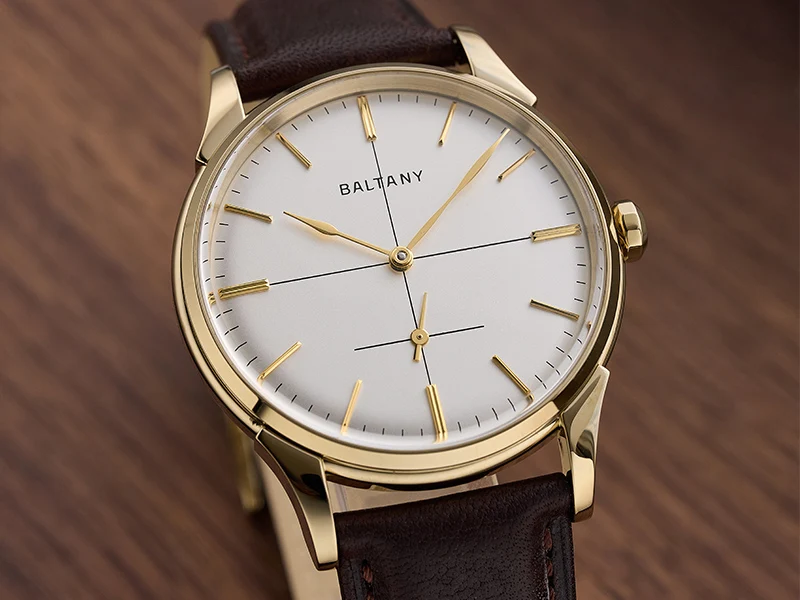
The ST1700 is the manual-winding version of the ST1701 — no automatic rotor, requiring daily crown winding. Used in the S4092 and S4101 manual variants. The removal of the rotor assembly allows the case thickness to drop to 9.3mm — the slimmest Baltany configuration available. If ultra-slim profile is the priority and you accept daily winding as part of the watch ownership ritual, the ST1700 is the correct choice.
Seagull ST1731 — Sub-Seconds Plus Date
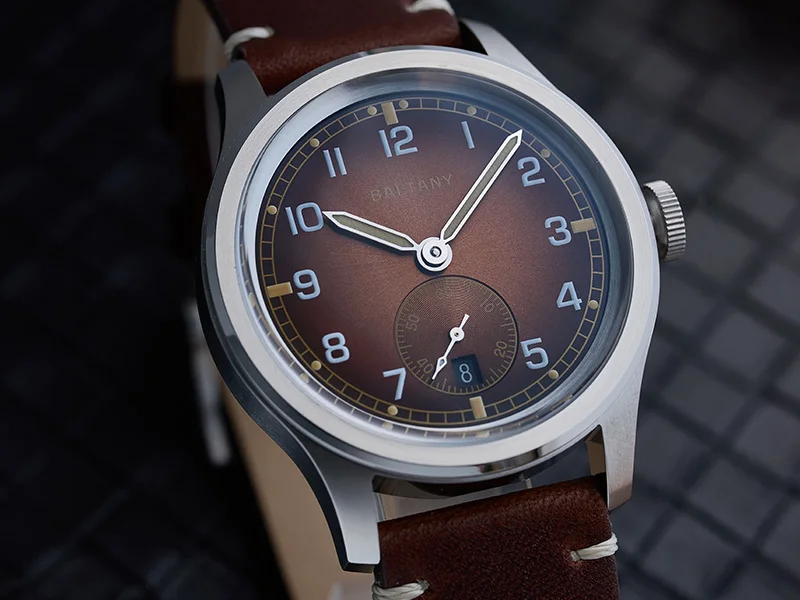
The ST1731 is used exclusively in the S2081 and is the only affordable automatic movement that combines a sub-seconds display with a date complication. Both complications appear on the dial simultaneously. This is what makes the S2081 unique in the Baltany range — no other model or movement provides this combination.
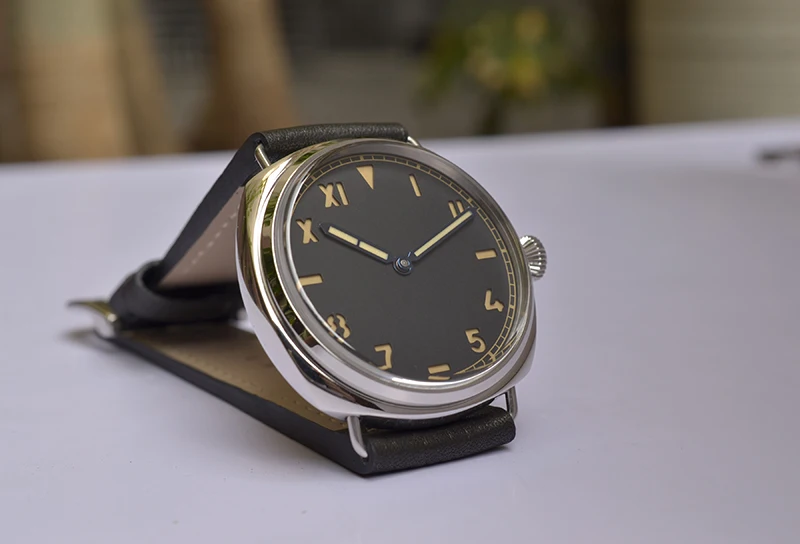
Seagull ST3600 — Large-Format Manual Wind
The ST3600 is an ETA/Unitas 6497-1 based manual-winding caliber used in the S4009H California dial. At 36.6mm movement diameter it is a physically large caliber — the largest in the Baltany range — which is part of why the S4009H requires a 44mm case. ~48-hour power reserve, small seconds at 9 o’clock, no hacking. The architecture is well-understood globally and has been in continuous production for decades.
The Quartz Movements
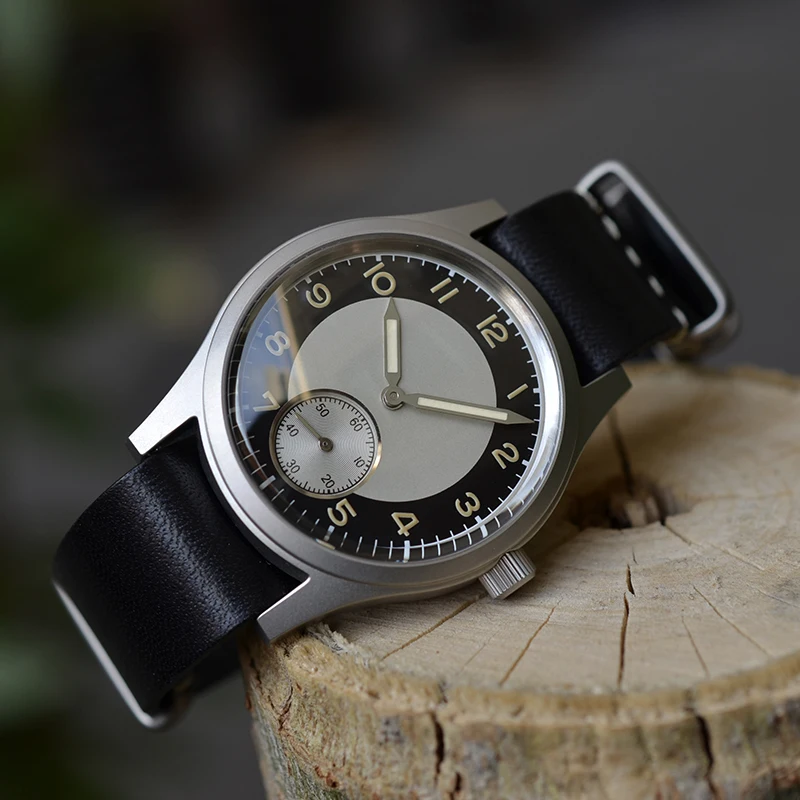
Seiko VD78 — Solar-Assisted Quartz
The VD78 is used in the D12 quartz field watch, S184012 bubbleback and S182027 tuxedo. It is a solar-assisted caliber that recharges via light exposure through the dial — regular daylight or indoor lighting exposure maintains the charge. Under typical daily wear, the battery effectively never needs replacement.
The VD78 also includes a sub-seconds display, which most quartz movements at this price do not offer. Accuracy is ±15 seconds per month — approximately 4–6x more accurate than a well-regulated mechanical automatic.
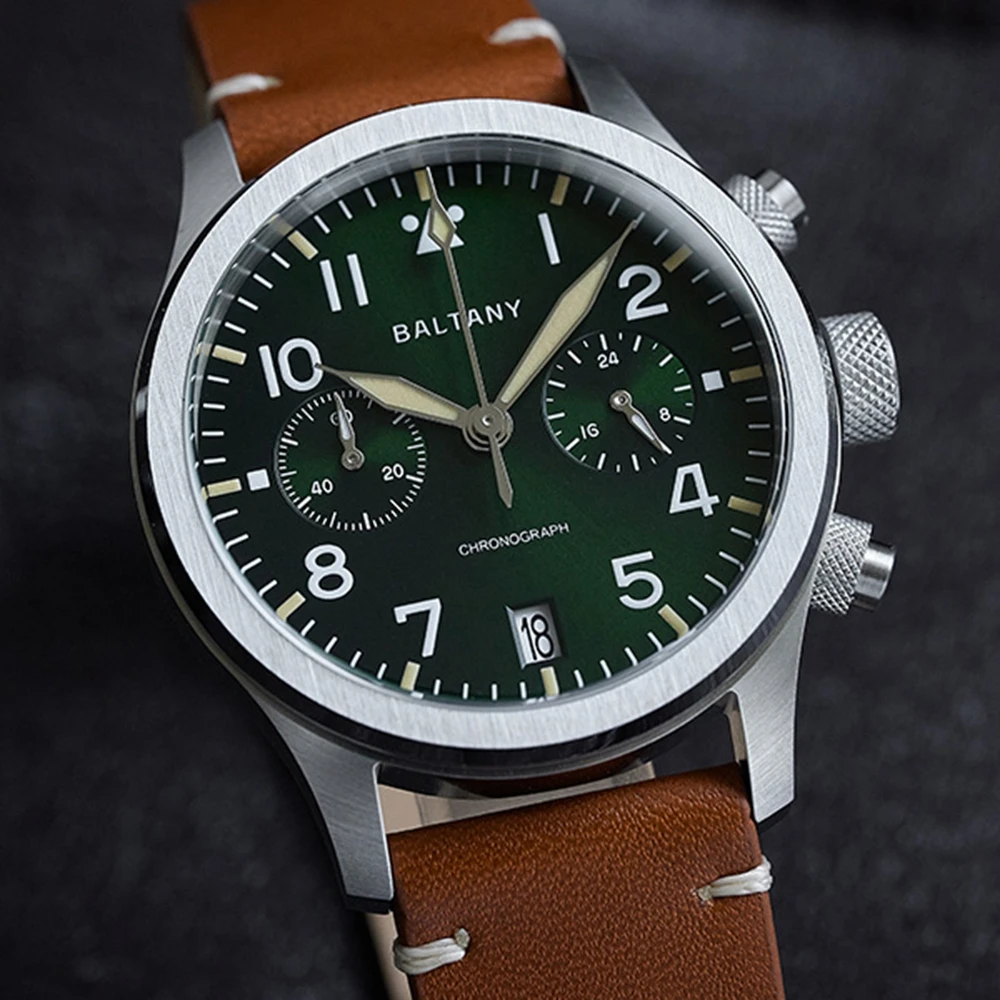
Seiko VK64 vs VK67 — Meca-Quartz Chronographs
Both the VK64 and VK67 are meca-quartz chronograph movements — quartz oscillator for timekeeping accuracy, mechanical module for the chronograph function. The result is a central chronograph hand that sweeps smoothly (like a mechanical chronograph) rather than stepping in 1/5-second ticks (like standard quartz chronographs).
VK64 — used in S205034 and S205043:
- 60-minute elapsed time register
- 24-hour sub-dial display
- No date
- Smooth-sweeping central chronograph hand
VK67 — used in S205045:
- Sub-seconds continuous display
- 60-minute elapsed time register
- 12-hour elapsed time register — measures total elapsed hours up to 12
- Date window
- Smooth-sweeping central chronograph hand
The key practical difference: the VK64 can only track elapsed periods up to 60 minutes. Once the minute register completes a full revolution the count is lost. The VK67’s 12-hour register tracks elapsed hours continuously across the full measurement window — relevant for any timed activity exceeding one hour. If you time events over one hour, the VK67 (S205045) is the correct choice. If you time events under one hour, either movement works.
Ronda 715Li — Swiss Quartz, 10-Year Battery
The Ronda 715Li is Swiss-manufactured and uses a lithium cell rather than standard silver-oxide batteries. The lithium cell is rated for approximately 10 years under normal operating conditions — compared to 2–3 years for standard quartz batteries.
On a 100m water-resistant watch with a screw-in caseback (the S2082), battery replacement requires a case opening that ideally involves a watchmaker. The 10-year battery life effectively eliminates this service requirement for a decade. For buyers who want a minimal-maintenance field watch with no automatic power reserve management, the Ronda 715Li is the strongest argument for choosing quartz over automatic.
Head-to-Head Comparisons
NH38 vs SW200 (in the S4056 and S204035)
| NH38 | SW200 | |
|---|---|---|
| Origin | Japan | Switzerland |
| Beat rate | 21,600 vph | 28,800 vph |
| Hacking | No | Yes |
| Hand-winding | Yes | Yes |
| Date | No | No |
| Seconds sweep | Slightly ticked | Noticeably smoother |
| Global serviceability | Excellent | Excellent |
| Price premium | Base | Higher |
Choose NH38 if: price is a consideration, you don’t need hacking, and Swiss manufacture is not a requirement.
Choose SW200 if: you want the smoothest possible seconds sweep, specifically want Swiss-made movement provenance, or need hacking for precise time-setting.
ST2130 vs SW200 (in the S204035)
The S204035 offers Seagull ST2130 (Chinese) or Sellita SW200 (Swiss) in the same 39mm case.
| ST2130 | SW200 | |
|---|---|---|
| Origin | China | Switzerland |
| Beat rate | 28,800 vph | 28,800 vph |
| Hacking | Yes | Yes |
| Thickness | 11.4mm total | 10.2mm total |
| Accuracy | ±10–20 sec/day | ±4–7 sec/day |
The important difference here: both beat at 28,800 vph — the smooth sweep is identical. The SW200 is 1.2mm thinner and regulated to tighter accuracy tolerances. For buyers who want the thinnest case and best accuracy, SW200. For buyers where Swiss manufacture and the extra cost are not priorities, ST2130 delivers the same visual experience on the wrist.
ST1700 vs ST1701 (in the S4092 and S4101)
| ST1700 | ST1701 | |
|---|---|---|
| Winding | Manual only | Automatic |
| Thickness | 9.3mm | 10.4mm |
| Daily maintenance | Wind crown daily | None required |
| Character | Purist engagement | Convenient |
Choose ST1700 if: the slimmest possible case (9.3mm) is a priority and you want the daily winding ritual as part of ownership.
Choose ST1701 if: you want the automatic convenience of self-winding without daily crown engagement.
VK64 vs VK67 (in the S205034/S205043 vs S205045)
| VK64 | VK67 | |
|---|---|---|
| Max chrono register | 60 minutes | 12 hours |
| Date window | No | Yes |
| 24-hour sub-dial | Yes | No |
| Water resistance (Baltany) | 50m (S205034) / 100m (S205043) | 100m |
Choose VK64 (S205034/S205043) if: you time events under 60 minutes, don’t need a date window, and want the 24-hour sub-dial or the vintage dress-sport aesthetic of the S205034.
Choose VK67 (S205045) if: you time events exceeding 60 minutes, want a date window on your chronograph, or specifically want the 12-hour register for multi-hour timing.
Movement Rankings by Criterion
Best seconds sweep (smoothest): Miyota 9039 / SW200 / Miyota 9015 (all 28,800 vph) > ST2130 (28,800 vph, looser tolerances) > NH35/NH38/ST1701 (21,600 vph)
Most widely serviceable: NH35 > NH38 > SW200 > Miyota 9015 > Miyota 9039
Most accurate (automatic): SW200 (±4–7 sec/day) > Miyota 9039/9015 (±10 sec/day) > NH35/NH38/ST17xx (±15–20 sec/day)
Lowest maintenance: Ronda 715Li (10-year battery) > VD78 (solar, no replacement) > all automatics
Most complication: Miyota 9122 (day + date + month) > Seiko NH34 (GMT + date) > Seagull ST1731 (sub-seconds + date) > NH35 (date only)
Slimmest case possible: ST1700 (9.3mm in S4101/S4092) > Miyota 9039 (10mm in S4090) > ST1701 (10.4mm) > NH35/NH38 (varies by case)
FAQ
Does the NH38 hack?
No. The NH38 seconds hand continues running when the crown is pulled for time-setting. If you need to stop the seconds hand for precise synchronisation, choose a Baltany with NH35, SW200 or Miyota 9015/9039 instead.
Is the SW200 worth the extra cost over NH38?
If you specifically want Swiss manufacture or the smoothest seconds sweep, yes. If neither matters to you, the NH38 delivers the same daily experience at a lower price.
Which Baltany movement is most accurate?
The quartz options — VD78 (±15 sec/month), VK64/VK67 (±10 sec/month), Ronda 715Li (±10 sec/month) — are significantly more accurate than any automatic. Among automatics, SW200 (±4–7 sec/day) is the most accurate, followed by Miyota 9039 and 9015 (±10 sec/day).
What is meca-quartz and why does Baltany use it?
Meca-quartz (VK64, VK67) combines a quartz oscillator with a mechanical chronograph module, producing a smooth-sweeping chronograph hand rather than the stepped tick of standard quartz chronographs. Baltany uses it on the vintage chronograph range because the smooth sweep is consistent with the mechanical chronograph aesthetic the watches reference, at a price point where a full mechanical chronograph would require significant cost increase.
Can I service a Baltany movement myself?
NH35 and NH38 are serviceable by most watchmakers globally — their construction is well-documented and parts are available. Seagull ST17-series movements are serviceable but fewer watchmakers outside Asia are familiar with them. For buyers who specifically plan long-term ownership with regular servicing, NH35 is the safest movement choice.
Which Movement Should You Choose?
I want the simplest, most reliable daily watch: NH38 — proven, minimal, widely serviced.
I want Swiss movement provenance: SW200 — available in S4056 and S204035.
I want the smoothest seconds sweep: SW200 or Miyota 9039 — both 28,800 vph.
I need a date window with hacking: NH35 — used in S4084, S4095, S4102.
I want sub-seconds on my dial: Seagull ST1701 or ST1731 — the only automatics in the range with this display.
I want sub-seconds AND date: Seagull ST1731 — exclusively in the S2081.
I want the slimmest possible case: ST1700 (manual) — 9.3mm in S4101 and S4092.
I want a GMT watch: Seiko NH34 — dedicated GMT in the S6074.
I want maximum movement specification: Miyota 9039 — exclusively in the S4090.
I want maximum complications: Miyota 9122 (complete calendar) — in the S6047.
I want the lowest maintenance: Ronda 715Li (S2082, 10-year battery) or VD78 (S184012, solar).
I want a chronograph with smooth sweep: VK64 or VK67 depending on whether you need the 12-hour register.
Browse the full Baltany collection at Jewelry Addicts and the complete Baltany buying guide to find the right model for your movement choice.








Leave a comment
You must be logged in to post a comment.