

SEA-GULL 1963 International Edition Review: Column-Wheel Chronograph
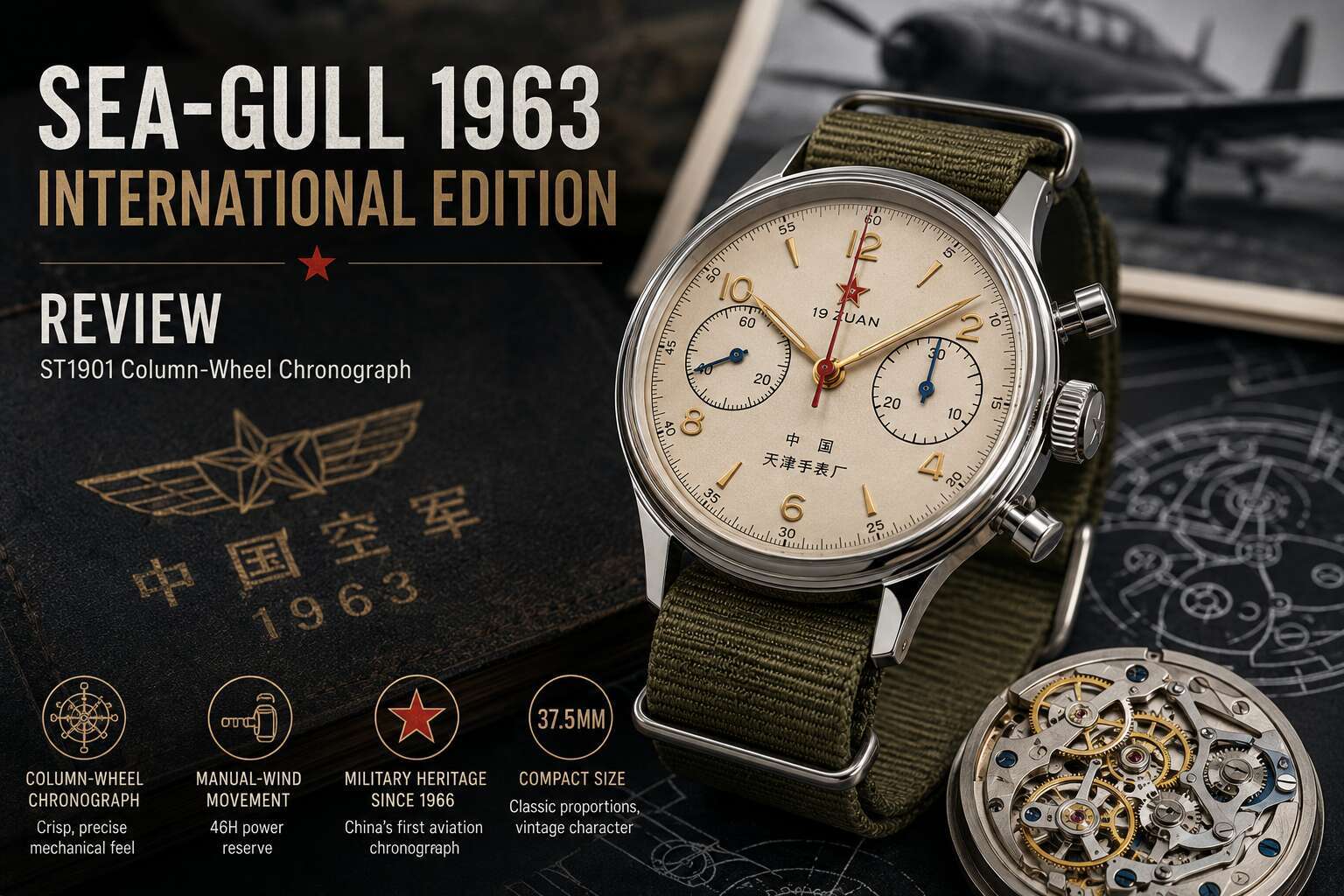
A watch review usually starts with a design language or a brand’s marketing pitch. The SEA-GULL 1963 deserves a different starting point, because almost everything interesting about it happened before the watch on your wrist was ever assembled.
This is a review of the SEA-GULL 1963 International Edition — specifically, what you’re actually buying, how the watch holds up against its own history, where the money genuinely goes, and who should (and shouldn’t) put one on their wrist.
The Short Version
The SEA-GULL 1963 International Edition is a manual-wind column-wheel chronograph built on the ST1901 movement — a caliber descended directly from China’s first military aviation chronograph, developed under a 1961 government mandate and put into service with Air Force pilots in 1966. At its price point, it offers a genuinely sophisticated chronograph mechanism (column-wheel, not the simpler cam-lever construction common in budget chronographs) wrapped in a faithful continuation of a real historical design, not a generic “vintage-inspired” pastiche.
The trade-offs are exactly what you’d expect from a watch in this category: 30m water resistance that demands real caution, a manual movement that requires daily engagement, and a crystal and case finish that won’t compete with watches several times the price. None of that is a surprise once you understand what you’re paying for — and what you’re paying for is mostly history and mechanism, not case materials.
Why the History Actually Matters Here
It’s easy to be cynical about brand heritage marketing. Most of it is invented after the fact, stretched to justify a price tag. The Seagull 1963’s story is the rare case where the history is the product, and it’s worth understanding before judging anything else about the watch.
In 1961, China’s Ministry of Light Industry gave the Tianjin Watch Factory — the company that would later become Seagull — a specific, high-stakes assignment: build the country’s first chronograph for Air Force pilots. At the time, China had no independent aviation watch capability and depended on foreign imports for this kind of precision instrument, which was a real strategic vulnerability.
The engineering team’s solution was pragmatic rather than purely nationalistic: they travelled to Switzerland and licensed patents and machinery from Venus, the Swiss manufacturer behind the Venus 175 column-wheel chronograph movement — at the time, and still today, a serious, well-regarded mechanism. This wasn’t a copy made by reverse-engineering smuggled parts; it was a formal technology transfer used as the foundation for an independent Chinese chronograph program.
The watch takes its “1963” name from the year the final prototype design was locked in. But the real production story took longer than the name suggests — sample units went through nearly two more years of military-grade testing for accuracy, temperature extremes, vibration resistance, and demagnetization before the design was approved. The first production batch, roughly 1,400 pilot’s chronographs, didn’t reach the front line until October 1966.
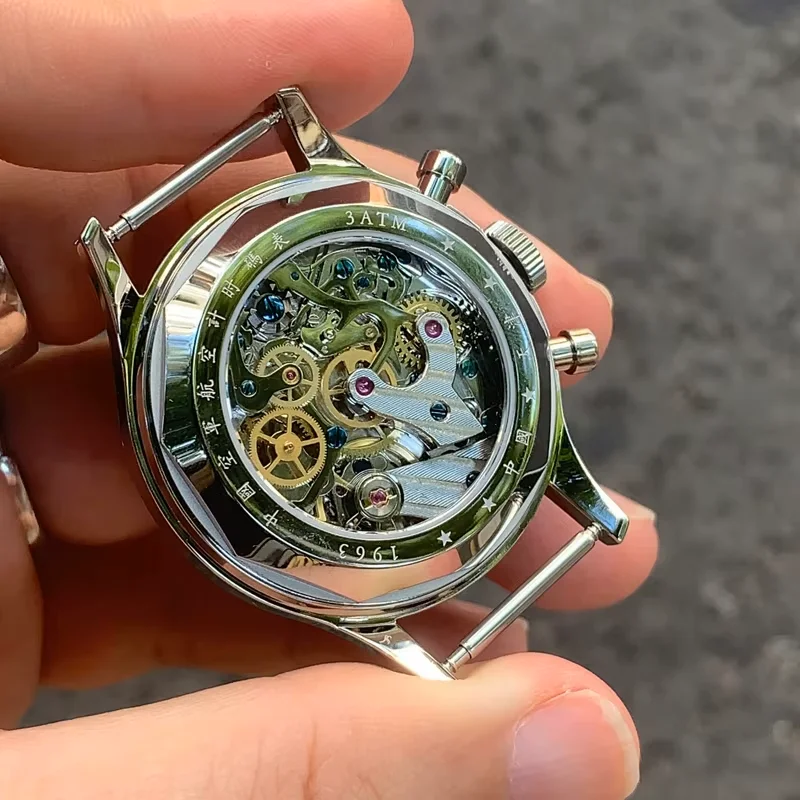
That movement — refined and modernized over six decades, but tracing an unbroken lineage back to that original Air Force project — is the ST1901 sitting inside the watch you’d be buying today. Genuine units carry the engravings “天津手表厂” (Tianjin Watch Factory) and “空军” (Air Force) directly on the movement, visible through the exhibition case back on the International Edition. That’s not a styling choice. It’s the same identifying mark that’s been on this movement family since pilots wore it operationally.
What “International Edition” Actually Adds
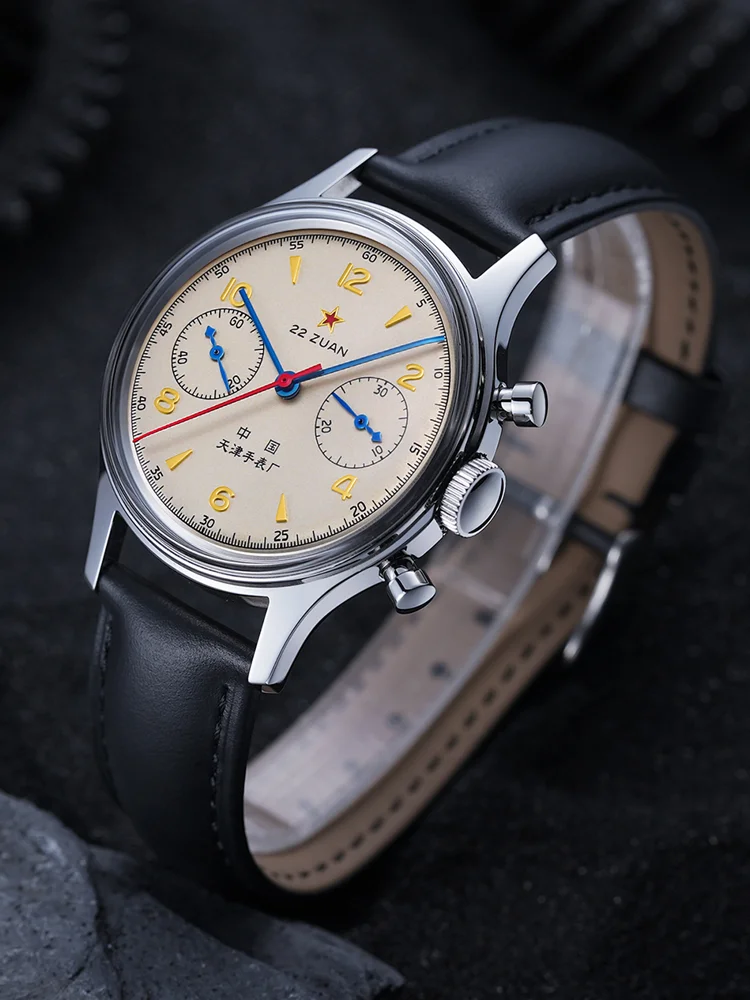
Seagull sells multiple tiers of the 1963 design, and it’s worth being precise about where this specific model sits. The International Edition adds two concrete upgrades over the base version of the watch:
- A transparent exhibition case back — letting you actually see the ST1901 movement, including its column-wheel chronograph mechanism, in motion.
- Glass crystal instead of acrylic — a meaningful step up in scratch resistance and clarity, though still below the sapphire found on Seagull’s higher tiers.
If you’ve seen other Seagull 1963 listings with sapphire crystal, a sapphire case back, or a swan-neck regulator visible through the movement, those are different, higher-priced tiers within the same family — not this watch. Knowing exactly which tier you’re buying matters more with this model than with most watches, because the visual differences between tiers can be subtle in photos but meaningful in person.
The Movement: What a Column-Wheel Chronograph Actually Gets You
Most budget mechanical chronographs — including a lot of watches costing considerably more than this one — use a cam-lever chronograph mechanism. It’s reliable and inexpensive to manufacture, but the action when you press the start/stop/reset pushers tends to feel slightly less precise, with more mechanical “give” before the function engages.
A column-wheel chronograph is a different, more complex design: a small wheel with columns coordinates the chronograph functions, providing a more direct and immediate response when the pushers are pressed. It’s the same fundamental mechanism class used in column-wheel chronographs from significantly more expensive Swiss manufacturers. The ST1901 isn’t a simplified imitation of that construction — it’s a genuine column-wheel caliber, with 22 jewels and a beat rate of 21,600 vibrations per hour, offering up to roughly 45 hours of power reserve from a full manual wind.
This is genuinely the watch’s strongest credential. Buyers spending two or three times this price on a “heritage chronograph” from other brands are often getting a cam-lever movement dressed up in vintage styling. Here, the mechanism complexity is real, not just implied by the design language.
The trade-off: it’s manual-wind only. There’s no automatic rotor, so the watch needs to be wound by hand, ideally daily, to keep accurate time and maintain its power reserve. For some buyers this is part of the appeal — a deliberate, tactile ritual rather than a chore. For buyers who want to take a watch off a shelf after two weeks and have it just work, this isn’t the right movement type.
Design and Dial — Faithful, Not Reimagined
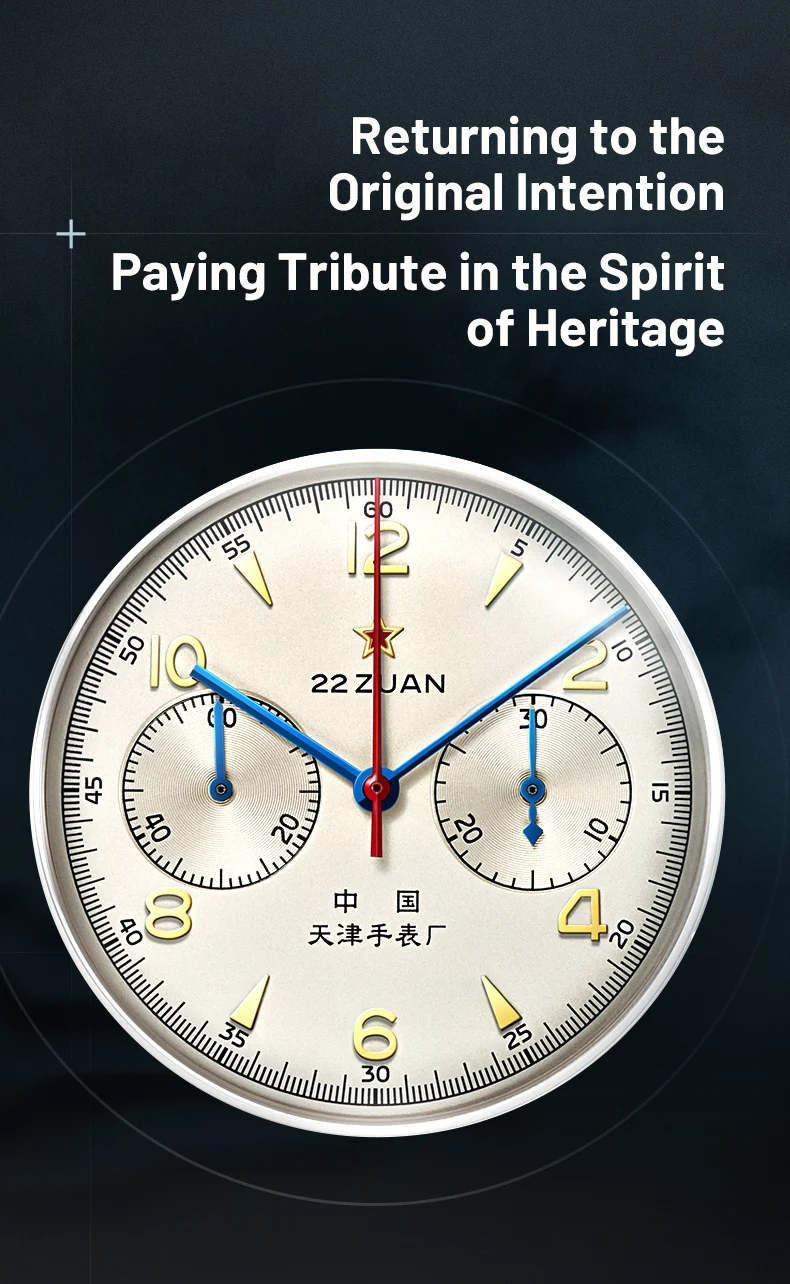
The dial follows the original 1960s two-register layout closely: a warm cream/yellow background, gold-tone Arabic numerals, blue sub-dial hands for the chronograph registers, and a long red central seconds hand for chronograph timing. A red star sits beneath 12 o’clock — a recurring motif across Seagull’s military-heritage line, and a detail that ties directly back to the watch’s Air Force origins rather than being generic vintage flourish.
This is a case where restraint works in the watch’s favor. A lot of “retro-inspired” watches over-design the vintage cues until the result feels like a costume. The 1963’s dial reads as an honest continuation of a real period design rather than a modern reinterpretation trying too hard to look old.
Build, Strap, and What You’re Not Getting
At roughly 37.5mm diameter and 15mm thick, the case sits on the smaller side of current trends — closer to genuine 1960s proportions than to the 40mm+ norm most contemporary watches default to. Whether that reads as “authentically vintage” or “small for modern taste” depends entirely on your wrist and your expectations; this isn’t a watch trying to compete with oversized sport chronographs.
The 316L stainless steel case construction is solid and appropriate for the price point, but this is where the International Edition’s cost savings versus higher Seagull 1963 tiers becomes most apparent: glass crystal rather than sapphire, and a closed-tier finish rather than the more elaborate case treatments (domed sapphire, 3D tachymeter engraving) found on Seagull’s “Times Edition” and other premium 1963 variants. None of this is a defect — it’s simply where the value engineering happens to keep the price accessible while preserving the part that actually matters, the movement.
The canvas/NATO strap option leans into the watch’s military character convincingly; the leather strap options (which include a bonus canvas strap and a strap-changing tool in the box) offer more dressed-down versatility if you want to wear the watch beyond a strictly field/aviation aesthetic.
Water resistance is rated at 3 Bar / 30m — daily splash protection only. This is not a watch to wear in the shower, let alone swimming, and the manual-wind crown and chronograph pushers add additional points where water ingress is a real risk if you’re not careful. Treat the rating as a baseline safety margin, not an invitation to test it.
Column-Wheel vs. Cam-Lever: Why This Distinction Is Worth Caring About
It’s worth slowing down on this point because it’s the single biggest factor separating the 1963 from most chronographs at a similar price, and it’s easy to gloss over if you don’t already know watch mechanisms.
A chronograph needs a way to coordinate three functions — start, stop, and reset — through a single set of pushers, engaging and disengaging various gears and levers in the correct sequence without grinding or jamming. There are two broad ways manufacturers solve this:
Cam-lever chronographs use a stack of flat cams and levers to control the sequence. They’re mechanically simpler, cheaper to produce in volume, and perfectly reliable for everyday use — the overwhelming majority of chronographs sold today, including many well-regarded ones, use this construction. The trade-off is usually felt in the pusher action: slightly more resistance, occasionally a touch of “mushiness” before the function actually engages, and a less immediate mechanical connection between your finger and the movement.
Column-wheel chronographs use a small wheel with vertical columns (resembling a tiny gear with raised teeth) that rotates a fraction of a turn each time a pusher is pressed, precisely directing the chronograph levers into position. It’s a more complex design to manufacture and has historically been reserved for higher-tier watches — the kind of mechanism you’d expect to pay a meaningful premium for. The payoff is a noticeably crisper, more positive pusher action and generally tighter mechanical tolerances throughout the chronograph train.
The ST1901 is a genuine column-wheel movement, not a cam-lever movement styled to look complicated. That’s a real, substantive specification — not marketing language — and it’s the primary reason this watch’s price-to-mechanism ratio stands out. You’d typically need to spend significantly more, often from established Swiss or Japanese chronograph specialists, to get column-wheel construction at all. Getting it here, attached to a movement with genuine military lineage, is the core of the value proposition.
How the ST1901 Compares Within Seagull’s Own Range
Because Seagull sells the 1963 design across several distinct tiers, it’s useful to understand where the International Edition sits without assuming it’s the only — or the top — option.
Higher tiers in Seagull’s 1963 lineup (sold under names like “Times Edition” or various anniversary reissues) typically add: sapphire crystal in place of glass, sapphire exhibition case backs rather than glass, upgraded swan-neck regulators (a fine-tuning component visible through the case back that improves rate adjustment precision), 3D-engraved tachymeter bezels, and sometimes slightly larger 40mm cases closer to contemporary sizing norms. These upgrades come at a meaningfully higher price point.
The International Edition sits as a genuine mid-tier option: it gets the movement upgrade that matters most (the transparent case back, letting you see the column-wheel mechanism work) and a real crystal improvement (glass over acrylic), without the cost of sapphire or the more elaborate case treatments found higher up the range. If your priority is specifically the movement and the history — rather than maximum scratch resistance or the largest possible case — this tier represents the more efficient use of your budget within the 1963 family.
Common Questions About This Watch
Is this watch a “real” Seagull, or a generic clone using Seagull-style branding?
Based on the confirmed specifications — genuine ST1901 movement, 316L stainless steel, the documented “1963 International Edition” naming convention used directly on Seagull’s own product lines — this is a legitimate SEA-GULL product, not a third-party clone borrowing the name. As with any purchase through a marketplace or reseller, confirming the seller’s authenticity guarantee before buying is sensible practice, particularly given how widely recognized (and occasionally counterfeited) the 1963 design has become.
Will I need to service this watch, and how often?
Mechanical chronographs, particularly manual-wind column-wheel movements under regular daily use, generally benefit from servicing every several years to maintain accuracy and prevent wear to the chronograph mechanism specifically — chronograph functions see more mechanical stress than simple timekeeping. This isn’t unique to the 1963; it’s standard practice for any mechanical watch with chronograph functionality.
Is the chronograph function a flyback, or standard start-stop-reset?
Some Seagull 1963 variants in the broader lineup include a flyback function (allowing the chronograph to be reset and immediately restarted with a single push, rather than requiring a separate stop-reset-start sequence). Whether this specific International Edition variant includes flyback should be confirmed against the exact model’s documentation before purchase, as this detail varies across tiers within the 1963 family.
How does the 37.5mm case wear compared to modern watches?
Modern watch design has generally trended toward 40mm+ cases over the past two decades, so a 37.5mm case will read as noticeably smaller and more vintage-proportioned than most contemporary releases. This is intentional — it reflects the original 1960s case sizing rather than a modern reinterpretation. Buyers used to larger watches should expect a different, more compact presence on the wrist.
Is the 30m water resistance actually usable for daily wear?
Treat 30m / 3 Bar as protection against incidental contact — rain, handwashing, light splashes — not as a meaningful safety margin for anything beyond that. The manual-wind crown and chronograph pushers represent additional ingress points compared to a simple three-hand watch, so the practical safety margin is arguably even tighter than the number alone suggests. This is a watch to remove before any deliberate water exposure.
Buy this if: you want a genuinely complex chronograph mechanism (column-wheel, not cam-lever) backed by real, independently verifiable military history, at a price that would otherwise only get you a much simpler movement from most other brands. You should also be someone who doesn’t mind — or actively enjoys — winding a watch daily, and who will treat a 30m water resistance rating with appropriate caution.
Look elsewhere if: you want an automatic movement you can set and forget, sapphire-grade scratch resistance as standard, or genuine dive-rated water resistance. The higher tiers within Seagull’s own 1963 range address some of these gaps (sapphire crystal options exist) at a higher price — worth comparing directly if budget allows.
Verdict
The SEA-GULL 1963 International Edition succeeds by being honest about what it is: an accessible entry point into a movement and a history that are both genuinely significant, without pretending to be something more expensive than it is. The column-wheel ST1901 movement is the real story here — a mechanism class typically reserved for far pricier watches, attached to a chronograph lineage with a documented, verifiable military origin rather than invented brand mythology.
It isn’t trying to be a dive watch, an everyday automatic, or a luxury dress piece, and judging it against those categories would miss the point. Judged as what it actually is — an accessible, historically grounded manual column-wheel chronograph — it’s a genuinely interesting watch for the price, and one of the few in this segment where the heritage story holds up to scrutiny rather than falling apart under it.
Related SEA-GULL Watches
For the specific product page with full technical specifications, see the SEA-GULL 1963 International Edition. For an automatic open-heart alternative from the same brand, see the SEA-GULL D819 Open-Heart Watch — ST2502 movement, day-date display, transparent case back.








Leave a comment
You must be logged in to post a comment.